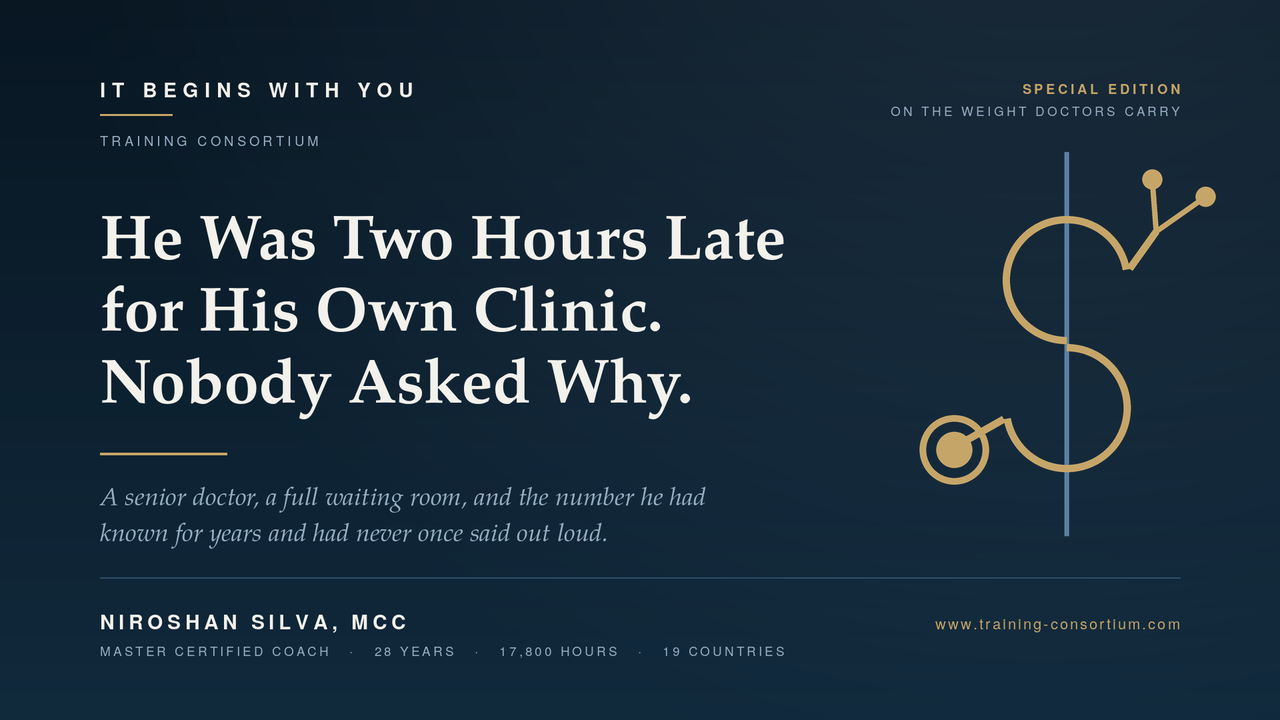
On World Suicide Prevention Day, a coach on the language that hides in plain sight at the top of organisations, the one direct question our profession is too often afraid to ask and why knowing exactly where coaching ends is what makes a coach safe to talk to.
He arrived for the session looking exactly as he always did. Well dressed. Calm. Prepared.
He had even brought the leadership action plan we had agreed at our previous session, neatly annotated, which is more than most senior clients manage. Nothing about him would have worried a board.
Something about him worried me.
He was speaking about his team as though he were no longer part of its future. “They will manage without me.” “My family will be financially secure.” “I have already handed over most of what people need.”
Sit in enough boardrooms and you will hear sentences like these applauded. We call it succession planning. We praise the leader who has built a team that no longer depends on him. That is exactly what makes this language so dangerous and so easy to miss.
I will call him Ravi and I owe you honesty about who Ravi is. He is not one client and nothing in this piece is a transcript of a real session. He is a composite, built from patterns that can arise in coaching, because what is said in a coaching room belongs to the person who said it. The pattern, however, is real and it is the reason I am writing to you today.
THE SENTENCE THAT SOUNDS LIKE GOOD LEADERSHIP
I must be careful here. None of Ravi’s statements, taken alone, proves that a person is thinking about ending their life. A coach must never diagnose from a sentence, a facial expression or one difficult week.
But experienced coaches learn to listen beneath the content of an answer. We listen for shifts in language, in energy, in how a person speaks about time and about the people around them. Ravi was no longer talking about solving his problems. He was talking about removing himself from them.
The research gives this a shape. The interpersonal theory of suicide, set out by Kimberly Van Orden, Thomas Joiner and colleagues in Psychological Review in 2010, proposes that the most dangerous form of suicidal desire tends to arise when two experiences meet : the sense of being a burden on others and the sense of no longer truly belonging, held together by a hopelessness that either will ever change.
Now translate that into the language of a senior leader. He will almost never say “I am a burden.” He will say the team would move faster without him. He will say the numbers would look better under someone else. He will say the family is provided for. As for belonging, I wrote recently about the weight leaders carry in silence, the names they cannot say and the fraud they fear they are. Loneliness at the top is real, and for some it slowly hardens into a verdict.
THE QUESTION I SET THE AGENDA ASIDE TO ASK
Our agenda that day was stakeholder relationships. I put it aside.
“Ravi, I want to ask you something very directly. Some of what you are saying makes me concerned about your safety. Are you thinking about ending your life?”
There was a long silence. Then he said, “I have thought about it.”
Many coaches, including very good ones, fear that question. They worry it will offend, damage trust or somehow place the idea in the client’s mind. The evidence does not support the last fear. A review by researchers at King’s College London, published in Psychological Medicine in 2014, examined thirteen studies and found none showing a statistically significant rise in suicidal thoughts as a result of being asked about them. The authors suggested that acknowledging and talking about suicide may reduce such thoughts rather than increase them.
So the question most coaches avoid is also the one least likely to do harm. The euphemism is what does harm. “You are not going to do anything silly, are you?” carries judgement and it quietly invites the client to reassure the coach. A plain question, “Are you having thoughts of suicide?”, tells the person that you can bear to hear the answer.
“A euphemism protects the coach. A direct question protects the client.”
If the answer is yes, coaching as usual stops. The objective is no longer insight, performance or accountability. It is safety.
WHAT A COACH MAY SEE BEFORE ANYONE ELSE DOES
A senior leader often shows the board a steady face, the family a reassuring one and the team a confident one. The coaching room may be the only hour in his week where nobody needs him to be fine. There is no single profile of a person in crisis and an admired executive, surrounded by people all day, can still be living with profound despair.
WHAT MIGHT GIVE A COACH CAUSE FOR CONCERN
▪ Repeated expressions of hopelessness, or of feeling trapped with no way out.
▪ Saying others would be better off without them, or speaking as if there is no meaningful future.
▪ Uncharacteristic withdrawal from colleagues, family or ordinary routines.
▪ Giving away responsibilities, possessions or important information, or unusual efforts to put affairs in order.
▪ A sharp decline in sleep, concentration, self-care or performance, or increased drinking.
▪ Intense shame after a failure, an investigation, a financial loss or a public setback.
▪ A striking loss of interest in goals that once mattered deeply.
▪ A sudden calm following a period of severe distress.
Some of these have other explanations. They do not turn a coach into a clinician and they never justify a label. They justify curiosity. Sometimes they justify a direct question.
WHEN THE ANSWER IS YES
Once a client acknowledges these thoughts, the conversation has to move from broad exploration to clear and compassionate questions. Tone is everything. This is not an interrogation. Stay calm, stay present, stay respectful.
QUESTIONS THAT SHOULD NOT BE LEFT UNASKED
▪ “Are you thinking about suicide now?”
▪ “Have you thought about how or when? Have you made any preparations?”
▪ “Do you have access to what you have thought about using?”
▪ “Have you harmed yourself or attempted suicide before?”
▪ “Are you alone at the moment? Who is one person you trust who could be with you?”
▪ “What has stopped you from acting on these thoughts so far?”
▪ “Would you be willing to speak with a mental health professional or crisis service now, and can we make that contact together before we finish?”
These questions are not a clinical assessment and they do not qualify a coach to declare anyone “safe”. Their purpose is to understand whether danger may be immediate and to connect the person with properly trained help. The more specific the intention, the preparation, the access and the timing, the greater the urgency.
WHAT HAPPENED IN THE ROOM
Ravi told me the thoughts had become more frequent. He had begun making preparations and he was afraid of what he might do when he was alone.
I said to him, “I care about what happens to you. This has moved beyond what coaching alone can safely hold. I would like us to contact professional support now and I will stay with you while we do.”
He asked me not to tell anyone. I did not debate with him. I reminded him, gently, of the limits of confidentiality we had agreed at the very start of our work and explained that when there is a serious and likely risk of harm, protecting his life comes before keeping every word private.
With his involvement, we contacted a family member he trusted and arranged an urgent professional assessment. Coaching was paused. Contact continued only within the boundaries agreed with the professionals now caring for him.
“The success of that session was not a leadership breakthrough. It was that Ravi did not leave the conversation alone”
A REFERRAL IS NOT A DOOR CLOSING
Coaches sometimes hesitate to refer because they fear the client will hear, “You are too difficult for me.” The message has to be the reverse. What you are going through deserves someone trained for exactly this, and I am walking with you towards them, not away from you.
A cold referral is a name on a card and the end of the conversation. A warm referral means helping the person make contact, involving a trusted support person where appropriate, confirming the very next step and following up within clear professional boundaries. Depending on the risk, that may mean a psychiatrist or clinical psychologist, the client’s doctor, a crisis service, a family member or emergency services.
If danger appears immediate, do not leave the person alone and do not abruptly end an online or telephone session. Know the law and the emergency procedures of the country where your client is physically sitting, which, on a video call, may not be your own.
WHAT OUR OWN PROFESSION ASKS OF US
The ICF Code of Ethics that came into effect on 1 April 2025 is clear on the essentials. Coaches must have a clear agreement with clients, sponsors and other parties about what confidential information may need to be disclosed and the Code names imminent or likely risk of danger to self or others among those circumstances. It also asks us to stay alert to signs that a client is no longer benefiting from coaching and ICF has published practical guidelines for coaches on referring a client to therapy.
None of this means every distressed client must leave coaching. Coaching and therapy can run side by side when roles and boundaries are clear. It does mean coaching must never become a substitute for mental health treatment. Presence is not clinical competence. Empathy is not risk assessment. A powerful question is not emergency care.
Knowing this about ourselves is precisely what makes us trustworthy.
It also means confidentiality can never become a hiding place. It has limits, and those limits belong in the contract, explained before the first session rather than invented in the middle of a crisis. When disclosure becomes necessary, share only what is required, with the appropriate person and record facts rather than interpretations. Then seek supervision. Coaches are human too, and a conversation like this stays with you long after the call has ended.
THE SILENCE ORGANISATIONS BUILD WITHOUT MEANING TO
The World Health Organization estimates that around 727,000 people take their own lives every year and that 73 per cent of those deaths occur in low and middle income countries, countries like our own. Behind each of those numbers is a family, a team, and a desk that somebody had to clear.
So today should not become another poster in the lift lobby. It should prompt harder questions in the boardroom. Can a senior leader in your organisation say they are struggling without being quietly marked down as weak? Is your employee assistance programme a real door or a number buried somewhere on the intranet? Do your coaching contracts spell out the limits of confidentiality? Before your leadership programme begins, have your coaches been given an emergency contact and a referral pathway?
A workplace cannot claim to support mental health while its people believe that asking for help will end their careers.
WHY THE QUESTION IS AN ACT OF HOPE
There is one more thing I want you to carry from this piece, because it changes how the question feels to ask. Speaking to The Sunday Times in 2023, the director of outreach at Sri Lanka Sumithrayo, which has offered emotional support in this country since 1974, said simply that the people who call “don’t want to die.” What they feel, the organisation explained, is hopelessness and helplessness, and no sight of a future.
Think about what that means in the coaching chair. When Ravi answered, “I have thought about it,” he was, perhaps, opening the only door he had left unlocked. The question did not bring the danger into the room. It had been sitting there all along, dressed as a handover plan. The question simply gave it somewhere to go other than silence.
A COACH DOES NOT NEED TO BE A RESCUER
We are not there to become anyone’s therapist, doctor or permanent emergency contact. We are there to notice. To listen without panic. To ask directly when there is reason to. To take the answer seriously, to know the limits of our profession and to walk the person towards someone properly trained to take the next step.
IF YOU NEED SUPPORT NOW
▪ If you or someone you know may be in immediate danger, contact local emergency services or go to the nearest hospital emergency department. Do not leave a person at immediate risk alone.
▪ In Sri Lanka, the National Mental Health Helpline, 1926, run by the National Institute of Mental Health, offers free and confidential support around the clock.
▪ Sri Lanka Sumithrayo offers free, confidential emotional support on 0707 308 308.
▪ Elsewhere, findahelpline.com and Befrienders Worldwide list crisis services by country.
Wishing you a week in which someone asks how you really are and stays for the whole answer.
Niroshan Silva, MCC. Written from the coaching room in Ratmalana, on World Suicide Prevention Day.