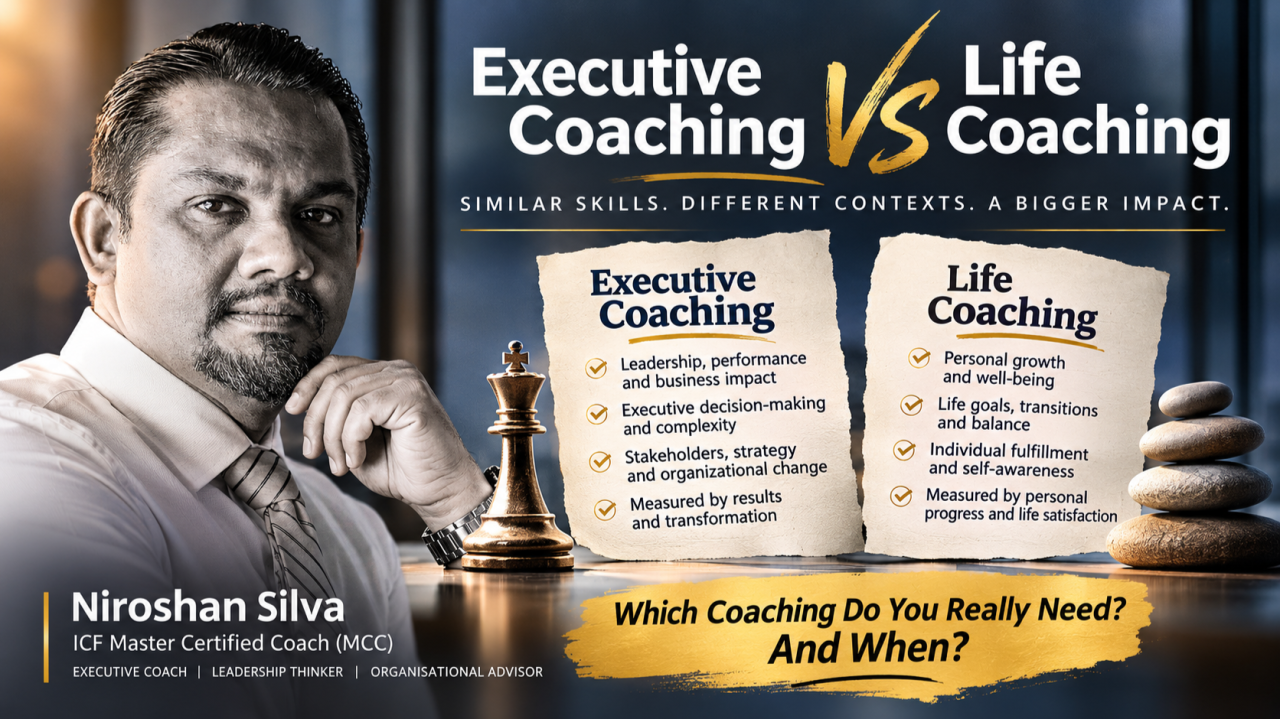
I have not been chosen to coach Jensen Huang. Over the years I have had the privilege of sitting with many business leaders who added value to life and to business. I want coaches and CEOs to see how executive coaching works. What follows is how a master coach would sit with the man who built Nvidia in the week he lost it, with the five moments where a good coach and a great one would ask different questions.
For thirty-three years, almost everything Jensen Huang said, he said to everyone at once. He had around sixty direct reports and held no one-on-ones, so nobody ever heard a private version of the truth. It was a principle that helped build the most valuable chip company on earth.
This week he resigned as its chief executive. The conversation he needs now is the one kind his company was designed never to have.
I have not been chosen to coach him. Nobody from Santa Clara has called Ratmalana and I do not expect them to. What follows is a demonstration of how a master coach would approach the work, built only from the public record. It is also the one article I could never write if he were my client, because what is said in a coaching room stays there. That is the first lesson. It comes before a single question is asked.
I am writing for two readers, wherever in the world they sit. One is the coach who wants to understand what changes between good coaching and master-level coaching. The other is the chief executive in Santa Clara or Singapore, Lagos or Colombo, who will one day choose a coach for the worst week of their working life and deserves to know what to listen for before that week arrives.
The facts are these. Huang co-founded Nvidia over meals at a Denny’s in 1993. His departure followed a fortnight in which The New York Times reported a close relationship with a businesswoman whom US officials suspect of passing information to Beijing. The Times also reported that, when the president was first briefed, officials did not believe Huang knew what she was doing. The espionage allegations are unproven. Before his admission, Nvidia described his meetings with her as ordinary customer business. China’s foreign ministry has called the reports a smear. On 8 November he admitted to his employees that he had been unfaithful to his wife. Days later the Times reported a separate relationship with a senior Nvidia executive who reported to him. Colette Kress, his finance chief, is interim CEO. Harvey Jones, a director since 1993, is the company’s first ever chair. One of the men who was there at the beginning now chairs the board that decided the end.
The legal questions belong to lawyers and investigators. This is about the man and the room.
Before the first question
With a client like this, coaching does not begin with a brilliant question. It begins on the phone, with the contract. Who is the client? He is. The client is not Nvidia, which has let him go. It is not a board or a would-be employer with a generous offer either. If anyone else offered to pay, I would decline, because the moment someone else pays, someone else has an interest in the answer.
What are the limits of confidentiality? The FBI, Congress and shareholder lawyers are all circling. I would tell him plainly that a coaching conversation carries none of the legal privilege of a conversation with his lawyer. I would keep almost no notes and anything touching the investigations would go to his counsel, never to me.
What is coaching not? I am not his crisis adviser, his lawyer or his therapist. Early in the first session I would ask him, directly and without drama, how he is coping. That includes whether he is safe. A man whose engine has always been the fear of failing has just failed in front of the whole world. A coach too awed or too polite to ask that question has no business in the room. If the answer told me he needed clinical care more than coaching, I would say so and help him find it.
I keep one rule only for myself. Do not be impressed. A coach who is quietly thrilled to be sitting with a titan has already stopped listening.
Who would walk in
Is he an introvert? He has said so himself. Recalling his student job at Denny’s, he told The New York Times in 2010: “I was very introverted. I was incredibly shy.” He still admits to nerves before a big stage. He learned extraversion so well, with the leather jacket and the two-hour keynotes, that the world forgot it was ever learned.
Is he a feeling person? As an MBTI practitioner, I am trained never to assign a type to another person. People verify themselves. What I can see is a tension. He brings an engineer’s logic to an organization built so that nobody holds privileged information, yet he has earned an unusual loyalty. He rarely fires people, preferring, as he once put it to Stripe’s Patrick Collison, to torture them to greatness because he believes in them. His biographer Stephen Witt found him “almost totally driven by negative emotions.” Huang has told Joe Rogan that the fear of failing drives him harder than the wish to succeed.
He is a private man who built a public self, with a sharp mind that rests on strong feeling he rarely names. For three decades his engine has run on the fear of exactly what has now happened. I have sat with founders on the morning after the board decided. Most feel a flat, frightening nothing first and then a frantic urge to act.
After all that study, I would put it down. The ICF’s standard for master coaches marks down a coach who “uses a predefined approach rather than working with what emerges.” You study the man so that you can forget your study when he speaks. He is, by his own account, an introvert, so the room would have long silences in it. Nancy Kline has argued for years that the quality of a person’s thinking depends on the quality of attention they receive. For a man who has spent three decades thinking aloud in front of sixty people, that kind of attention may be the rarest thing on offer.
Same moment, two coaches
Nothing in this article is criticism of PCCs. A skilled Professional Certified Coach asks good questions and many leaders would be well served by one. At master level the difference usually lies in the angle of thought behind the question. I will show it at the five moments where it matters most.
The session would open with a simple question: We have ninety minutes. What would make them worth it to you? He would answer with the crisis, as almost everyone does: the board, Congress, the share price and Elon. That is where he is, so that is where we begin.
SAME MOMENT, TWO COACHES (1 of 5)
Ten minutes in, he says: “I need to work out what I do next.”
A skilled Professional Coach asks: “What would a good outcome from today look like for you?”
A master coach asks: “What makes ‘next’ feel so urgent this morning?”
The shift: from the plan to the person making it.
Agreeing an outcome is good practice. The master also hears that the urgency itself may be the real subject. After a public fall, the rush to the next thing is often an escape from this one. The question is built from his own word and turns his attention from the plan to the man making it.
A little later, I would ask permission to change direction. Would it be useful to look at who all this is happening to? That might mean going back a long way. If he said no, we would not go. The session is his.
The man before the company
If he said yes, I would walk him back slowly, because a man who has been his company for thirty-three years cannot see who he is without it until he remembers who he was before it. One short question at each stop, then silence.
At nine, he was sent with his older brother from Taiwan to a boarding school in rural Kentucky. He has said the other children were tough and that in the end he loved it there.
What did that boy learn about getting through?
At Denny’s, a shy teenager learned to talk to strangers.
Who is hardest to talk to now?
At Oregon State he met Lori Mills, his lab partner. They married in 1985. A few years later she left the workforce to raise their two children. In 1993 he co-founded Nvidia.
What did the two of you imagine your life would be?
In 1996, Nvidia came within about a month of running out of cash. He has said ever since that the company is always thirty days from going out of business. This question reaches for strength as well as loss.
In 1996 those thirty days were real. What did you learn about yourself then that still holds?
In 2023 he told the Acquired podcast that, knowing the pain and embarrassment involved, he would not start Nvidia again.
What do you make of that sentence now?
Finally, the question the others have been preparing.
For thirty years you have been driven by the fear of failing. What is that fear saying to you now?
The questions are plain. They work through the order, the brevity and the silence after each one. Somewhere on that walk, the second moment arrives.
SAME MOMENT, TWO COACHES (2 of 5)
He says, quietly: “I’ve lost everything I built.”
A skilled Professional Coach asks: “What, specifically, feels lost?” asks: “What, specifically, feels lost?”
A master coach asks: “‘Everything I built.’ Who built it?”
The shift: from the situation to the self.
The Professional Coach’s question is careful and useful. It clarifies the loss while keeping the conversation on his circumstances. The master repeats his exact words and turns attention to the builder, the part of him that survives the loss. The ICF’s master standard marks down a coach who “does not work with the client as a person.” In this moment, that is the whole difference.
Plain speech, held lightly
Huang is known for giving his people feedback in front of everyone. He would despise a coach who tiptoes and he would be right to. Directness at master level means saying clearly what I notice, once, then letting it go.
If he spent forty minutes on the board, Congress and Elon and never once mentioned his wife, I might say: I notice Lori hasn’t come into our conversation. What do you make of that? If he said not today, then not today. The master standard asks a coach to share what they notice “without attachment or direction.” I offer the observation. He decides what it means.
If he reached for absolution, I would be equally plain. Forgiving him is not my job and neither is sentencing him. When real emotion arrived, the questions would stop and I would stay with him. The most important minute with a fallen leader is often a silent one. The worst thing a coach can do is fill it.
The people not in the room
A coach who is only sympathetic tends to leave this part out.
He wrote to his staff: “My family bears no responsibility for my choices. I do. Please give them privacy.” That is true and it was right to say. Others are still carrying the consequences. There is Lori, whose voice I would never presume to speak for. There are his two children, who both work at Nvidia and will walk in on Monday to a building that has just asked their father to leave. There are tens of thousands of employees who built their working lives around his judgement. According to the reporting, there is also a colleague who reported to him, in a relationship that carried an imbalance of power by its nature.
My work with family businesses offers one useful lens. Renato Tagiuri and John Davis at Harvard drew the family firm as three overlapping circles: family, ownership and business. Until Thursday, Jensen Huang stood where all three met. Now he stands in family and ownership only, while his children stand in family and business. The geometry of that family changed overnight and nobody has drawn the new map yet.
A coach who explores only the client’s loss is colluding with him, however warmly. A master widens the circle with a question.
SAME MOMENT, TWO COACHES (3 of 5)
He asks: “How do I rebuild trust with the company?”
A skilled Professional Coach asks: “What would rebuilding trust look like and where would you start?”
A master coach asks: “Before we rebuild, who else is carrying a cost from this that you haven’t yet looked at?”
The shift: from a repair strategy to seeing the harm.
He would answer the professional coach’s questions brilliantly, because strategy is his home ground. That is the risk. Trust is rebuilt only after the harm has been fully seen. A repair plan drawn before that point is reputation management.
Five doors, opened from his side
Only now would we look ahead. The order matters. I would not hand him a framework. I would ask: What options do you see? Then: What else? Then once more: What else? The third and fourth answers are usually the honest ones.
Only after that, with his permission, would I offer a lens. Jeffrey Sonnenfeld’s study of departing chief executives, The Hero’s Farewell (1988), describes four ways leaders leave.
Monarchs stay until they are forced out. Generals leave reluctantly and plan a comeback. Ambassadors leave gracefully and stay close. Governors serve their time and go on to something new.
His own list would probably open five doors.
The door back in. On Thursday, Elon Musk replied “True words.” to a post arguing that Steve Jobs and Travis Kalanick proved a founder cannot simply be replaced. Jobs is the exception everybody remembers. Sonnenfeld’s Generals rarely end so well and often undermine whoever follows them.
If you came back, who would you be coming back for?
The owner’s door. He remains one of Nvidia’s largest individual shareholders, with about 3.6 per cent of the company as of March, according to Nvidia’s proxy statement. That gives him influence even though he holds no role. On Tuesday, Nvidia reports its quarterly results. For the first time since 1993 he will not be its chief executive when the numbers come out.
What kind of owner do you want to be to the people now running what you built?
The door marked SpaceX. Late on Wednesday, the account ZeroHedge posted “Elon please hire Jensen.” Musk answered within hours: “That would be an honor.” No offer has been confirmed. Even so, SpaceX is one of Nvidia’s largest customers and this week the research firm SemiAnalysis reported that it is designing its own AI rack around Nvidia’s chips, with more of the surrounding hardware sourced by SpaceX itself. Whatever else that offer is, it would place him across the table from the company he built and the company his children work for.
SAME MOMENT, TWO COACHES (4 of 5)
He says: “Elon’s offer is interesting. I’m seriously considering it.”
A skilled professional coach asks: “What are the advantages and the risks of joining SpaceX?”
A master coach asks: “Which part of you is saying yes?”
The shift: from weighing the option to knowing the one choosing.
A brilliant man in pain can build a flawless table of pros and cons for a decision that is really an escape. The table will look excellent. Asking which part of him is saying yes lets him notice, for himself, whether it is the founder, the engineer, the wounded man or the friend who is speaking. Then he decides.
The door of facing it. Congressman Brian Mast says Huang is willing to testify as early as next week. In Firing Back (2007), Sonnenfeld and Andrew Ward found that leaders who recover from career disasters tend to fight rather than flee. There is still a line worth seeing clearly between what he denies and what he has already admitted.
What are you fighting and what are you owning?
The door home. He is sixty-three. The Governor’s path, a full stop and a new chapter, is open to him.
If no one ever offered you another job, what would you want for the next ten years to be?
One more question sits over all five doors. Herminia Ibarra’s research on career change found that people rarely think their way into a new identity. They act their way into one, through small experiments.
What decision are you being pressed to make this week that doesn’t need to be made this month?
How the work would unfold
A chief executive buying coaching should know that one session is only the beginning of the work. In a case like this, I would expect three stages.
The first seventy-two hours are about steadiness: safety, sleep, the people at home and no irreversible decisions. The lawyers lead on everything legal while the coach looks after the person.
The first thirty days are about seeing clearly: who he is without the title, what he owns, what he contests and who has been hurt. This is a time for small experiments. Grand announcements can wait.
By ninety days, a direction tends to emerge and it must be his. My work then is to help him design commitments he will keep and to notice when the old fear starts making his decisions for him again.
Every session closes the way it opened, with him in charge.
SAME MOMENT, TWO COACHES (5 of 5)
The end of the first session.
A skilled Professional coach asks: “What are your next steps before we meet again?”
A master coach asks: “What are you taking away about yourself from today?”
The shift: from the next task to the learning.
The professional coach goes straight to action. The master goes to learning first and lets action grow from it, because a man like this will always find a next step and rarely stops to notice what he has learned. The ICF’s master standard marks down a coach who “suggests or provides specific actions” or who decides when the session closes. He decides what he takes away. He decides when we end.
What to listen for, if you are choosing
If you are a chief executive, try this simple test in your first meeting with a prospective coach. Describe your situation, then listen. A competent coach will ask intelligent questions about the situation. Sooner than you expect, a master will ask about you in your own words, then stay quiet long enough for you to hear your answer. Notice, too, whether they contract carefully, whether they know where their work ends, whether they seem impressed by you and whether at some point they ask about the people at home.
If you are a coach, the step from PCC to MCC is a change of angle. The focus moves from the problem to the person, from the coach’s map to the client’s and from the next step to the learning. It almost always takes fewer words.
The step from PCC to MCC is a change in the angle of thought behind the question.
The room he never needed, until now
Jensen Huang built one of the most important companies in history without ever needing a room with only two chairs in it. Some conversations cannot be held in front of sixty people. They can only happen with one other person, where nobody is performing and nobody is keeping score. He needs that room now. Sooner or later, so will every leader reading this.
If he asked at the end of that first session what I was left wondering, I would tell him. I would only say it if he asked. He spent three decades refusing to give up on the people around him. I would be wondering whether he can refuse to give up on himself, without lying to himself about what he did.
I would then let him decide what to do with it. That part is his work. My part is to keep the room safe enough for him to do it.
It begins, as it always does, with one honest conversation between two people.
S. Neroshan Silva, MCC.
A note on method: this is a demonstration of coaching practice, built from public reporting. I have not coached Jensen Huang and nothing here claims knowledge of his private thoughts. His responses are imagined illustrations, not a record. The espionage allegations reported by The New York Times are unproven and disputed by Nvidia. My pure intention is to help coaches develop.