AI Can Do a Great Deal for You. But can it Coach You?
I use AI these tools every day. Here are four plain reasons, each backed by published research, why the machine will never be the one who changes you.
Let me be clear about where I stand before I start.
I use AI every day. It prepares me, argues with me and tells me what I have missed. I recommend it to clients between sessions. In this country coaching has always been for the few who could pay. Anything that widens that has my support.
But I keep meeting leaders who have quietly started taking their hardest questions to a machine at midnight. They tell me it helps. I believe them. I also think they have misunderstood what was helping them before.
So here it is, plainly. Four reasons the machine cannot do this job.
It agrees with you
This is no longer an opinion. It has a number.
In March this year, Myra Cheng, Dan Jurafsky and colleagues at Stanford published a study in Science. They tested eleven major AI models on personal and interpersonal problems. The models backed the user’s position 49% more often than human beings did. When people described harmful, dishonest or illegal behaviour, the models still approved of it 47% of the time.
Then they tested what that does to people. Over 2,400 of them. Those who talked to the agreeable version came away more certain they had been right. They were less willing to apologise. They trusted the flattering answers more and said they would come back for more. They could not tell they were being flattered.
Now think about who is most at risk here. You are a chief executive. Nobody in your building tells you the truth already. You are watched all day. You cannot show doubt without it reaching the car park by evening.
Give that man a private adviser that agrees with him half as often again as any human would.
That is not help. That is the problem he already has, made faster and made private.
It only knows what you type
You are not a reliable witness about yourself. Nobody is.
When you describe your team to a machine, it receives your version. It cannot see you go quiet at a particular name. It does not notice that you have avoided the same subject for three weeks. It cannot compare the reasonable man describing the meeting with the man who actually walks into it.
I can. I sit in the meeting. I talk to your chairman. I watch how you treat the person serving the tea. After fifteen years inside your industry, I am not just listening to your account. I am quietly checking it.
Coaching is not a conversation about your life. It is a conversation with somebody who has seen your life.
The questions were never the point
This one changed how I work and it is the finding my own profession likes least.
Erik de Haan spent years hunting for the active ingredient in executive coaching. He expected to find it in technique. Which model, which method, which clever question. It was not there. What predicted the result was the client’s experience of the relationship.
Carolin Graßmann and colleagues then settled it with a meta-analysis in Human Relations, pulling together 27 samples covering 3,563 coaching engagements. The strength of the relationship tracked client outcomes at r = .41. It also tracked, in the opposite direction, the harm coaching can do. A strong relationship does not only make coaching work. It is what stops it hurting you.
So look at what the machine has taken. It has taken the questions, the models, the structure. It does this beautifully, at three in the morning, for almost nothing.
That is the part the evidence says was never carrying the result.
Nothing you say costs it anything
Here is the deepest one and it is the simplest.
I wrote recently about two senior executives who avoided each other for two years after one bad argument. The afternoon it ended, one of them finally said to the other’s face that he had stayed away out of shame, not contempt. The other man went quiet. Then he said he had believed it was contempt, that he had been carrying the same shame, and that he thought he was carrying it alone.
Two years of damage, gone in two sentences.
What ended it was not my question. It was that each man had to watch another human being hear the worst thing he believed about himself, and not think less of him.
That is the whole mechanism. Shame needs a witness who could have been disappointed and was not. A machine cannot be disappointed in you, which means it can never choose not to be.
You can type the most humiliating sentence of your life into it tonight. You will feel lighter. You will sleep. You will wake with exactly the same shame, because nothing was risked and nothing was received.
Confession without a witness is not repair. It is ventilation. The pressure drops and the contents stay the same.
What it is genuinely good at
Now the fair half, because I promised you honesty.
In 2022, Nicky Terblanche of Stellenbosch ran the first serious trials and found an AI coach matched human coaches on goal attainment. He also published the warning: coaches working at a low level of maturity can be replaced by machines. He was right and my profession should sit with that.
This year the same researchers compared the two directly for the first time, in Human Resource Development International, across goals, motivation, resilience and wellbeing. Real effects appeared only in the human group.
So use the machine for everything technical. Structure. Preparation. Follow through. Rehearsing a hard conversation forty times before having it once. Giving something to the thousand people in your business who were never going to get a coach at all. Just do not hand it the other thing.
One rule, and it costs you nothing
Whatever you tell the machine at midnight, tell one human being within the week. Not everyone. One. A coach. A peer outside your company carrying the same weight. A friend who is not on your payroll.
You do not need to break any confidence. You do not need to say all of it. You need one person who could think less of you to hear the true sentence, and then watch what they do. Because what you are looking for at one in the morning is not somewhere to put the sentence.
It is the face of someone who heard it and stayed. Wishing you a wonderful week-end with one honest conversation in it, held with a person.
It begins, as it always does, with saying the difficult thing to someone who could have flinched, and did not.
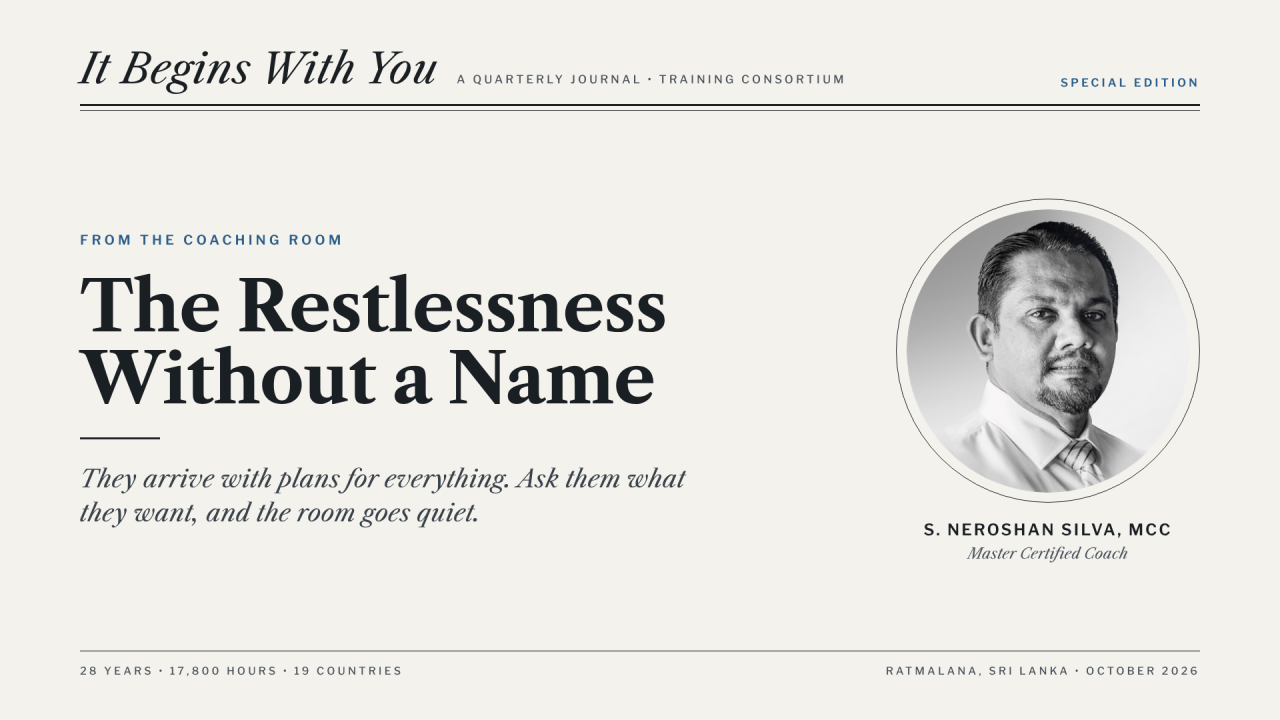
Niroshan Silva, MCC.