The Ten Minutes in the Car Park
There is a particular kind of morning that almost nobody in business describes out loud. It is ten to eight. You are sitting in the car park. The building in front of you is the same building it was a month ago and you cannot make yourself walk into it.
Nothing dramatic has happened. You are not ill and you are not resigning. Something went badly wrong a few weeks ago, in front of people whose opinion matters, and since then you have been carrying something you have no vocabulary for at your level, so you have been calling it tiredness.
The incident itself is usually ordinary. A board presentation that came apart in the first ten minutes. A number you defended in public that turned out to be wrong. A decision that cost real money, made while everyone watched. Survivable, all of it. Colleagues told you to put it behind you, and outwardly you did.
Look, though, at what has quietly changed. You speak later in meetings than you used to. You have stopped volunteering for the difficult brief. You send work out for a second opinion you would never have sought a year ago. Nothing on the organisation chart has moved. The company is still paying for the leader it hired and is quietly receiving a smaller version and nobody has noticed except you.
What Actually Broke and What Did Not
Your ability did not go anywhere. That matters more than it sounds. Albert Bandura spent decades separating two things most organisations still treat as one.
There is what you can do and there is your belief that you can reliably do it when it counts.
He called the second self-efficacy, and he showed that it is built above all from mastery experience, the first-hand evidence of having done the thing successfully yourself. Encouragement from other people is a much weaker ingredient.
That is exactly why one loud public failure does damage out of all proportion to its size. It does not remove the skill. It contaminates the evidence file, with a single entry more vivid than the two hundred quieter entries above it.
The organisation has not lost the capability. It has lost access to it, and there is no line in the management accounts for that.
What decides whether that withdrawal lasts a month or five years is not the scale of the incident. It is what you decided the incident meant. You decided that early, alone and usually badly.
The Verdict You Passed in the First Week
Martin Seligman’s work on explanatory style, set out in Learned Optimism in 1990 and carried to a wider business readership by Sheryl Sandberg and Adam Grant in Option B, identifies three moves that turn a setback into a lasting injury.
1.Permanence, the belief that this is simply how things are now.
2. Pervasiveness, the belief that it touches everything.
3. Personalisation, the belief that it is you.
Watch how fast a sentence travels. I handled that meeting badly becomes I always lose my nerve when it matters, becomes I am not actually commercially sharp, becomes I am the problem here.
Senior people are peculiarly exposed to the third move, because they have spent whole careers being rewarded for taking ownership.
There is a difference and it is not a small one, between accepting responsibility for a decision and converting that decision into a permanent description of yourself. The first makes a leader better. The second makes a leader smaller. Very few executives can tell you which one they have been doing, because both feel like integrity.
Rehearsing Is Not Reviewing
You will tell me you have analysed it thoroughly. You have gone over it perhaps forty times.
Susan Nolen-Hoeksema’s research on how people respond to distress, refined with Wendy Treynor and Richard Gonzalez in 2003, splits that activity in two.
Brooding is a passive circling of your situation against a standard you failed to meet, and it produces nothing.
2. Reflection is a deliberate turn inwards aimed at solving something.
At two in the morning, from the inside, they are almost indistinguishable and only one of them is any use.
Reflection ends in a next action. Brooding ends in a better worded version of the same accusation.
So there is a plain test. If the fortieth replay has produced no instruction, you are not reviewing the incident. You are rehearsing it and every rehearsal deepens the groove.
Why Good Advisers Cannot Advise Themselves
Here is the part that should relieve you a little.
In 2014, Igor Grossmann and Ethan Kross published three experiments in Psychological Science involving close to seven hundred participants. People reasoned demonstrably more wisely about other people’s difficulties than about their own, recognising the limits of what they knew and allowing for other points of view. They called it Solomon’s paradox. The asymmetry vanished when participants were instructed to consider their own situation from a distance instead of from inside it.
So the fact that you talked a colleague through almost exactly this last year and cannot do it for yourself now, is not further proof of your weakness. It is the ordinary geometry of standing inside your own head.
It is also the whole structural case for coaching, which has little to do with comfort and a great deal to do with distance.
The Questions I Would Ask You, in Order
If you were sitting across from me, this is roughly the sequence. The order does more work than the wording.
Tell me what happened, in the order it happened, with no adjectives. Most people cannot manage thirty seconds. The adjectives are the verdict smuggled in among the evidence, and when you strip them out, what is left is very often a smaller event than the one being carried.
Which part of this was actually yours? Not the whole of it. Your part, precisely. Amy Edmondson’s work at Harvard on learning from failure places organisational failures on a spectrum, most of them with causes spread across process, information, resourcing and plain complexity. Almost nobody applies that spectrum to their own failure. Precision here is not self-exoneration. It is the only route to a correction you can actually make.
What is the sentence you have been saying to yourself since? Say it aloud, in my hearing, exactly as it runs in your head. Most of these sentences do not survive the journey into open air. They were built for the dark.
Is that a description of what you did or a verdict on who you are? How long is it true for, and where exactly does it stop being true? This is where permanence and pervasiveness are made to defend themselves, and they rarely can.
Who has watched you do this well, more than once, over years? Give me names. This is not flattery. If first-hand mastery is the strongest thing a person can stand on, you have a decade of it on file and have simply stopped opening the file.
If your closest colleague sat where you are sitting, holding exactly what you are holding, what would you tell him? Then, more quietly: why is that counsel available to him and not to you? Regular readers of this journal will recognise the shape of that question. It works because of Solomon’s paradox, not in spite of it.
What is the smallest real thing you could do this week that would give you evidence rather than reassurance? Then the last one, which is usually the hardest: who have you not told?
Evidence, Never Reassurance
Notice what is missing from that list. Nowhere do I tell the person they are still good at their job.
Bandura’s ordering is the reason. Being told you are capable is the weakest input available. It is why a well-meaning chief executive saying forget it, it happens to everyone, changes nothing and occasionally makes matters worse, because now you are also a person who needs consoling.
The instinct after a public failure is to withdraw until the confidence comes back, then step out again. That sequence is the wrong way round, and it is why so many capable people never fully return.
Confidence is not the ticket you buy before the journey. It is the receipt you are handed afterwards.
So the work is deliberately small, deliberately soon and deliberately visible. Not the board. The next meeting in which you have a view, spoken first, before you talk yourself out of it.
The Repair Nobody Has Been Told About
There is one more piece and most leaders get it wrong because it offends their dignity.
Marshall Goldsmith and Howard Morgan examined more than eighty-six thousand responses concerning over eleven thousand managers across eight companies, published in strategy+business in 2004. The variable that predicted whether colleagues actually saw a leader improve was not the programme and not the coach. It was whether the leader told colleagues what he was working on and kept coming back to them about it. Leaders who skipped that step showed improvement barely better than chance.
Apply that here. Other people’s picture of you after a visible failure does not update on its own. It updates through contact. Which means the private recovery, conducted quietly so that nobody sees the wound, is precisely the recovery that never reaches the people whose opinion you are most afraid of.
You can be entirely repaired on the inside and remain, in your organisation’s mind, the person who got that one thing wrong.
Saying it out loud to two or three colleagues costs something. It is also the only mechanism anyone has real evidence for.
Boards ought to care about this more than they do. Juliana Breines and Serena Chen, across four experiments published in 2012, found that people who met their own mistakes with self-compassion rather than with self-esteem repair were more motivated to improve, spent longer preparing after a failure and were readier to make amends. The hard self-criticism most executives believe is protecting their standards may be quietly eroding the accountability it claims to defend. A good leader running at seventy percent for eighteen months after one bad quarter is an expensive asset, and nothing in the reporting pack will ever show it.
What I Am Asking of You This Week
The incident is a fact. The verdict is not. The verdict is something you passed on yourself in the first week, in a court where you were the only witness, the only prosecutor and the only judge, and where nobody called the two hundred witnesses for the defence who have worked alongside you for years.
You are still passing it, this morning, in a car park, on your own.
So do two things before Friday. Say the sentence out loud to one person who has earned the right to hear it. Then do one small visible thing that gives you evidence instead of comfort. Not the grand return. The small one, done early, in front of somebody.
It begins, as it always does, with refusing to treat your own verdict on yourself as final.
Wishing you a week in which you are a little kinder to the person you have been hardest on.
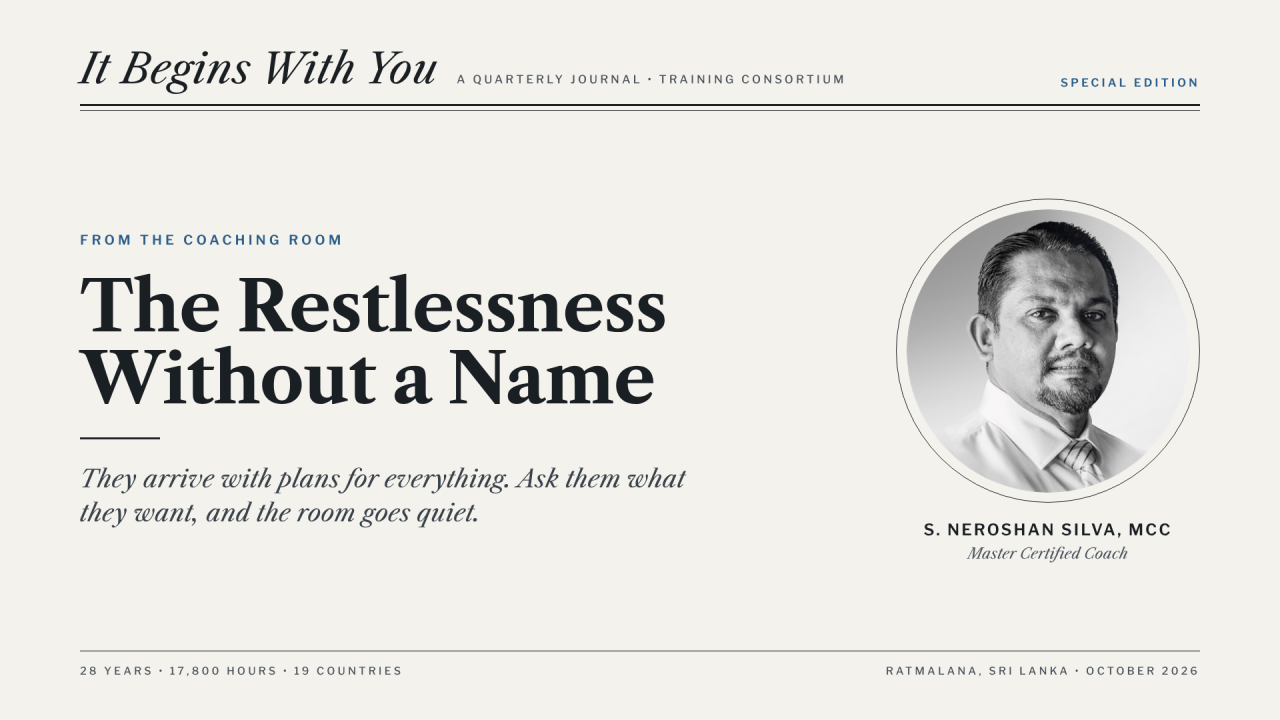
Niroshan Silva, MCC. Written from the coaching room, in Ratmalana.